 how-to
7 Ways to Keep Ice Cream Frozen While Transporting It in a Car
Last Updated: October 30, 2026
Quick Summary
For transporting ice cream in a car, start with rock-hard product and a pre-chilled cooler, then pack gel ice packs in layers with a towel or foil barrier and fill every air gap. Keep the cooler on the car floor out of direct sun and leave the lid closed until you arrive.
- Set your home freezer to its coldest setting the night before a trip.
- For trips under 1 hour, a pre-chilled cooler plus two frozen gel packs is enough for a few pints.
- In mild weather, use one 1-pound gel pack per quart of ice cream for every 2 hours of transit.
- Choose a cooler that leaves no more than 1 to 2 inches of empty space on any side.
- Never place dry ice in a cooler that is completely airtight, because gas must escape.
Table of Contents
- Start Colder Than You Think: Pre-Chilling Before the Drive
- How to Keep Ice Cream Frozen in a Cooler
- How Long Ice Cream Lasts in a Cooler by Trip Length
- The Best Cooler for Transporting Ice Cream
- How to Transport Ice Cream Without Dry Ice
- Dry Ice in a Passenger Car: Safety Rules and Capacity Math
- Where to Put the Cooler in the Car and How to Manage Cabin Heat
- Food Safety After the Drive: What to Refreeze and What to Toss
- Frequently Asked Questions
Start Colder Than You Think: Pre-Chilling Before the Drive
The single best thing you can do for transporting ice cream in a car happens before the car ever moves.
Most melting problems start at the freezer door, not on the road. A pint that has softened on the counter for ten minutes has already lost the head start you need.
Here is the pre-chill routine we recommend:
- Set your home freezer to its coldest setting the night before a trip.
- Move the ice cream to the back of the freezer, where cold air sits.
- Chill your cooler and ice packs in the freezer overnight, not the fridge.
- Load the car last, right before you leave.
Pre-chilling is the practice of bringing both the dessert and the container down to deep-freeze temperature before packing.
Watch out: packing a warm cooler is a common mistake.
How to Keep Ice Cream Frozen in a Cooler
Keeping ice cream frozen in a cooler comes down to three things: a cold start, good insulation, and as little trapped air as possible. Get those right and a standard hard-sided cooler handles most trips.
Layer Ice Packs and Insulation Correctly
Build the cooler in layers, bottom to top. Cold sinks, so put your heaviest cooling power low and around the sides.
- Line the bottom with gel ice packs.
- Add a folded towel or a sheet of aluminum foil as a barrier.
- Set the ice cream in the middle, away from the walls.
- Pack more ice packs around the containers.
- Cap it with another towel, then close the lid fast.
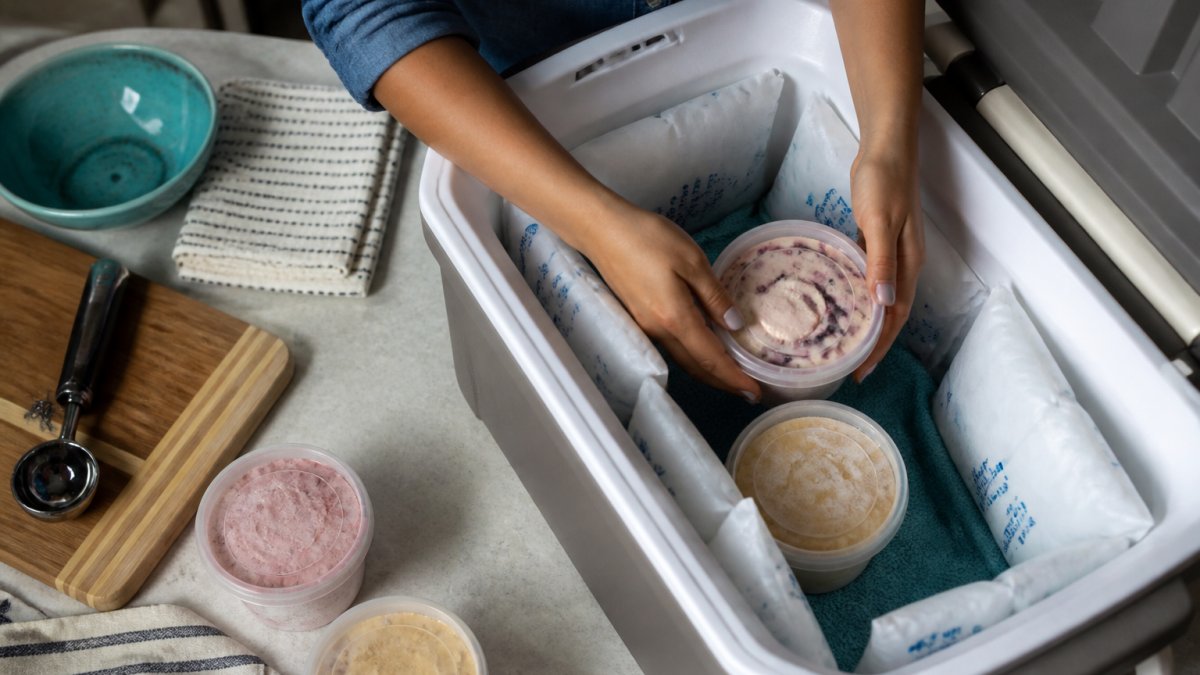
Aluminum foil reflects heat and adds a thin radiant barrier. It is not a substitute for insulation, but it helps.
Pack Tubs Tight to Eliminate Air Gaps
Air is the enemy. Every empty pocket inside the cooler is warm air waiting to steal cold from your ice cream.
Fill the gaps. Crumple newspaper, add a spare towel, or nestle smaller pints between larger tubs. Tight packing keeps cold air where it belongs: against the product.
- Group pints and tubs so they touch each other.
- Fill open space with towels or crumpled paper.
- Never leave the top third of the cooler empty.
For a deeper look at packing technique, our guide on how to transport gelato without melting walks through the same layering method step by step.
How Long Ice Cream Lasts in a Cooler by Trip Length
How long ice cream holds firm in a cooler depends on outside temperature, cooler quality, and how often the lid opens. Instead of guessing, use trip duration and weather to build a packing plan.
A Decision Guide for Short, Multi-Hour, and Hot-Weather Trips
Short trips (under 1 hour): A pre-chilled cooler plus two frozen gel packs is enough for a few pints. Keep the cooler on the floor, out of direct sun, and do not open it until you arrive.
Multi-hour trips (1 to 4 hours): Use a full layer of gel packs on the bottom, a towel barrier, and packs around the sides.
Hot-weather or extended trips (4+ hours): Dry ice becomes practical. Dry ice can extend cold-holding time on longer trips, but always err on the side of more cooling and keep the lid closed.
Capacity Math: Cooler Size and Pack Count
A cooler packed full holds cold far better than a half-empty one. To estimate cooler size, add the volume of your containers and then choose a cooler that leaves no more than 1 to 2 inches of empty space on any side. For gel packs, a common pattern is one 1-pound pack per quart of ice cream for every 2 hours of expected transit in mild weather. In hot weather, use one pack per quart for every hour.
What to Do If Ice Cream Softens
If ice cream softens but is still cold, it can be refrozen, though texture may suffer. If it has warmed substantially, discard it. Never refreeze fully melted ice cream for guests. Maintaining a stable environment inside your vehicle is just as critical as the insulation of your cooler, and reducing interior car heat remains the most effective way to protect the integrity of your frozen goods during transit.
Match your packing plan to the length of the drive and the weather outside.
| Trip length | Packing approach | Notes |
|---|---|---|
| Under 1 hour | Pre-chilled cooler plus two frozen gel packs | Keep on floor, out of direct sun |
| 1 to 4 hours | Full layer of gel packs on bottom, towel barrier, packs around sides | Do not open until arrival |
| 4+ hours or hot weather | Dry ice becomes practical | Err on the side of more cooling |
| Gel pack estimate, mild weather | One 1-pound pack per quart for every 2 hours | Based on expected transit time |
| Gel pack estimate, hot weather | One pack per quart for every hour | More cooling in heat |
| Cooler sizing | No more than 1 to 2 inches of empty space on any side | Packed full holds cold better |
The Best Cooler for Transporting Ice Cream
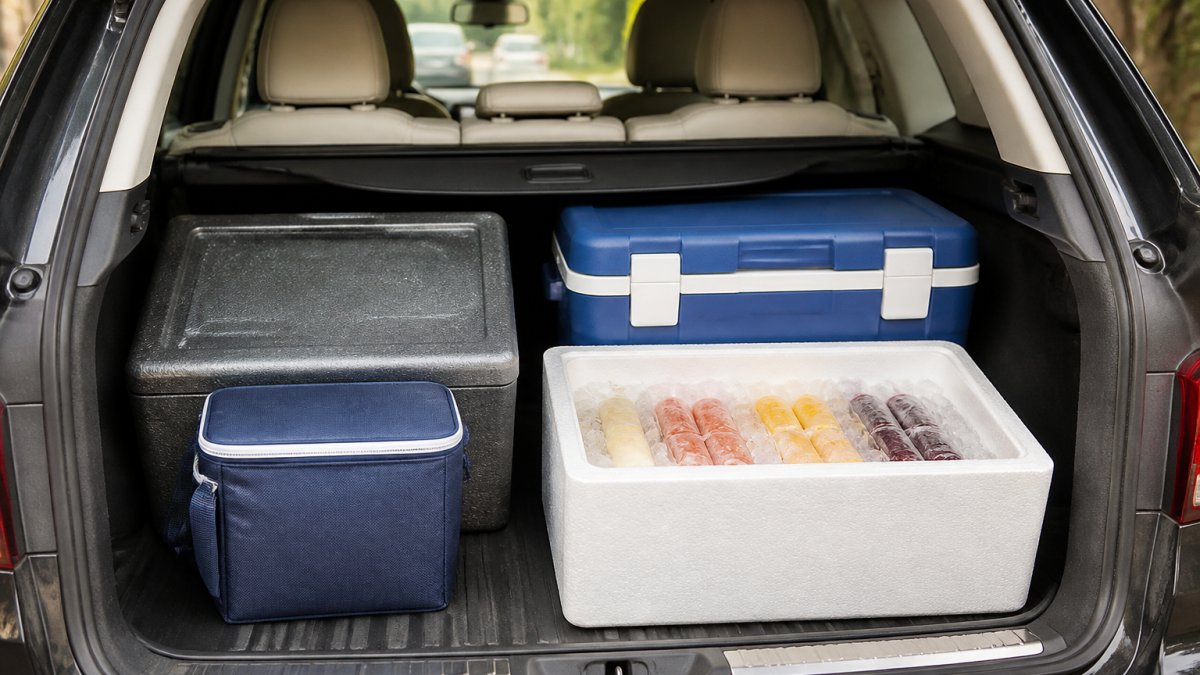
The best cooler for transporting ice cream is a hard-sided, thick-walled model with a tight-sealing lid, sized to fit your load with little empty space. Soft bags work for quick errands but lose the cold faster.
What matters most:
- Thick insulation. Rotomolded or thick foam walls hold cold far longer than thin plastic.
- A tight lid gasket. A lid that seals keeps cold air in and warm air out.
- The right size. A cooler packed full beats a big cooler half empty.
- A flat, stable base. It should sit level on the car floor.
For specific container picks, see our roundup of the best insulated containers for frozen desserts. We would rather point you to the right box than guess at specs.
How to Transport Ice Cream Without Dry Ice
You can transport ice cream without dry ice using gel ice packs, a pre-chilled insulated cooler, and tight packing. Dry ice is powerful, but it is not required for most trips.
Gel ice packs are the workhorse here. They stay cold for hours, they do not leak, and they are safe to handle.
A few habits make the no-dry-ice method reliable:
- Freeze gel packs solid, not slushy.
- Use more packs than you think you need.
- Keep a spare set frozen for the return trip.
- Skip opening the lid to "check" on things.
If you want a full walkthrough of electricity-free transport, our guide on how to transport frozen desserts without electricity covers the whole approach.
Dry Ice in a Passenger Car: Safety Rules and Capacity Math
Dry ice works, but it demands respect in a closed vehicle. Dry ice is solid carbon dioxide, and as it warms it releases CO2 gas (the CDC). In a sealed car, that gas can build up, so never store dry ice in a sealed passenger cabin without ventilation (the CDC).
Ventilation and Handling for Passenger Vehicles
- Ventilate the cabin with open windows. Do not rely on air conditioning alone.
- Keep dry ice in a cooler with the lid loosely fitted, never sealed airtight. Pressure can build and the container can fail.
- Wrap dry ice in paper or a towel, never bare against skin. Use insulated gloves when handling.
- Do not let dry ice touch the ice cream directly; place a barrier such as cardboard or a towel between them.
- Vent the car for several minutes before anyone sits inside for long, especially children and pets.
Capacity Math: How Much Dry Ice for the Trip
Use a barrier between dry ice and product, and do not overpack.
Where to Put the Cooler in the Car and How to Manage Cabin Heat
Put the cooler on the car floor in the shade, run the air conditioning, and keep direct sunlight off it.
The car floor stays cooler than the seats or the trunk lid. Direct sunlight through glass can heat a cooler fast, so shade matters.
- Place the cooler on the floor, not on a seat in the sun.
- Run the AC and aim a vent toward the cooler's side.
- Crack the windows slightly to keep air moving.
- Park in shade at stops, and never leave the cooler in a parked hot car.
Vehicle ventilation and air conditioning are your allies. For a step-by-step plan on managing heat at outdoor events, our guide on how to keep frozen desserts cold outdoors lays out seven practical steps.
Food Safety After the Drive: What to Refreeze and What to Toss
Refreezing depends on how cold the ice cream stayed. If it is still firm and icy, it can go back in the freezer.
Here is our simple test:
- Still firm and frosty: refreeze it.
- Soft but cold: use it soon; do not refreeze for a later event.
- Fully melted and warm: toss it. Do not serve it.
Melted and refrozen ice cream loses texture and can become icy. More important, a product that warmed into the danger zone is not something to serve at a catered event.
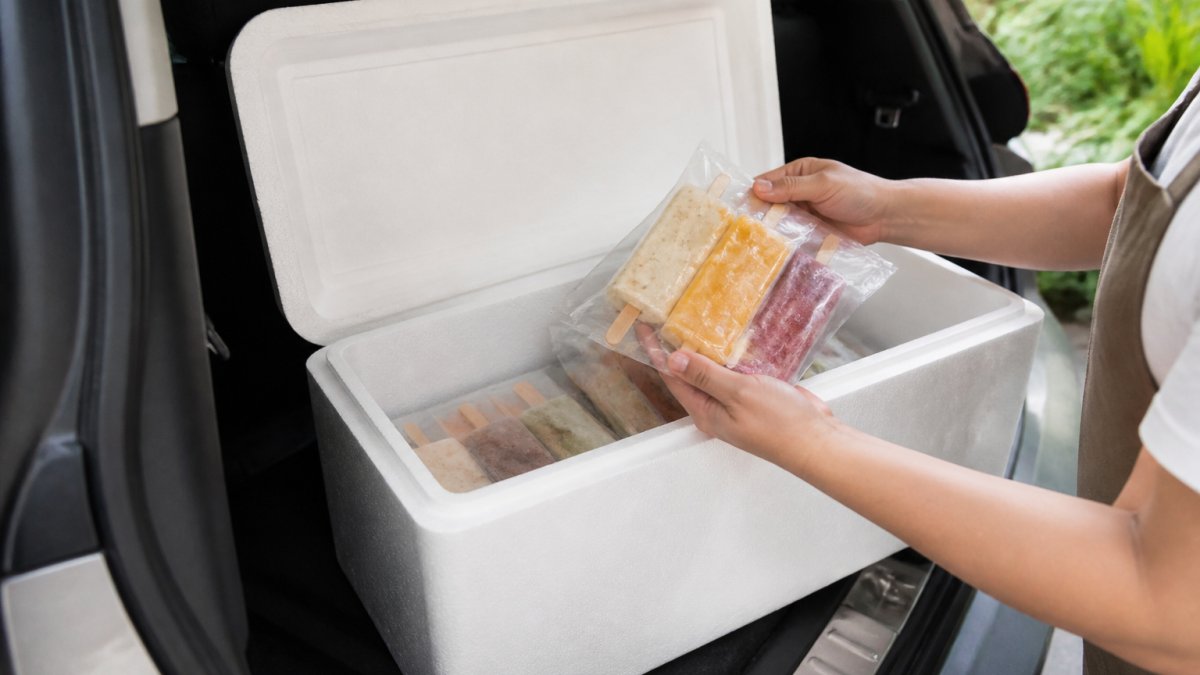
At Pepito's Paletas, our patented 8-hour frozen signature box provides electricity-free delivery of gourmet vegan paletas for offices, weddings, and client dinners.
Frequently Asked Questions
How do you keep ice cream from melting in a car?
Start with ice cream that is already frozen solid, then move it straight from the freezer into a pre-chilled insulated cooler packed with gel ice packs. Fill empty space with towels so there are no air gaps, and keep the cooler on the car floor in the shade rather than in a sunny trunk or back seat. Run the air conditioning on warm days and avoid opening the lid during the drive. For drives over four hours, add dry ice or use a delivery service built for frozen transport.
How long can ice cream stay frozen in a cooler?
A quality hard-sided cooler packed tight with gel ice packs holds ice cream firm for roughly two to four hours in mild weather. Cheap soft bags may only manage an hour or two. Adding dry ice extends that window, and a purpose-built insulated shipping box can hold frozen desserts for longer. Heat, sunlight, and how often you open the lid all shorten that window, so plan for less time on hot days.
Should ice cream go in a cooler or an insulated bag?
A hard-sided insulated cooler wins for anything beyond a short errand. Its thick walls and tight lid hold cold air far better than a thin insulated bag, and it resists the temperature swings of a parked car. Insulated bags work for a 15 to 30 minute drive to a nearby party, especially if you add a gel pack and keep the bag on the floor with the AC running. For long-distance transport, skip the bag.
Can you refreeze ice cream that melted during a car ride?
It depends on how far it melted. Ice cream that softened but stayed cold can usually go back in the freezer and refreeze, though the texture may turn icy or grainy. If it melted completely and sat warm for an extended period, throw it out. When in doubt, toss it. Never refreeze ice cream that feels warm to the touch.