 how-to
How to Plan Solar Powered Catering Equipment
Last Updated: October 31, 2026
Quick Summary
Plan solar powered catering by first auditing every appliance's running watts, startup surge and daily runtime, then sizing panels and batteries to that load. Most operators run refrigeration, lighting and POS on solar while keeping high-draw cooking equipment like griddles and fryers on propane.
- A 6 kWh daily load needs roughly 1,200 to 1,500 watts of panel capacity to break even.
- Size the battery bank for one to two full days of consumption, such as 12-15 kWh for a 6 kWh load.
- Add a surge allowance of about three times running watts for compressor-driven appliances.
- Sort appliances into solar-friendly, solar-possible with capacity, and better on propane or grid.
- Use a data logger in each refrigerator and freezer to document temperatures during outages.
Table of Contents
- Start With an Equipment Load Audit
- Sizing Solar Panels for Food Trucks
- Building Battery Power for Catering Equipment
- Inside a Solar Powered Food Truck Setup
- Choosing Off-Grid Catering Equipment That Actually Works
- Food Safety and Compliance When the Power Drops
- Get a Quote for Electricity-Free Dessert Catering
- Frequently Asked Questions
Start With an Equipment Load Audit
Solar powered catering equipment only works when the system matches what you actually plug in. For any operator running griddles, refrigerators, or rotisseries off a photovoltaic system, the audit comes first. Everything downstream, panel count, battery bank, inverter size, depends on two numbers: how many watts you draw and how long you draw them.
Skip this step and you buy equipment twice.
List Every Appliance and Its Wattage
Walk your trailer with a clipboard and write down every device that draws power. Then find the nameplate rating on each one. A typical mobile setup may include:
- Electric griddle (1,500-3,000 watts)
- Vertical rotisserie (1,200-2,000 watts)
- Refrigerator or display cooler (300-800 watts running)
A common mistake is listing only what runs at once. Write down everything, then mark which items run simultaneously during your busiest hour. That peak number drives the inverter and battery sizing.
Account for Startup Surge and Daily Runtime
Motors and compressors pull far more current at startup than they do while running. A refrigerator rated at 500 running watts can spike to 1,500 watts for a few seconds when the compressor kicks on. Griddle thermostats and rotisserie motors behave the same way.
Multiply running wattage by daily hours to get watt-hours, then add a surge allowance of roughly three times the running watts for compressor-driven appliances. A cooler running 500 watts for 10 hours consumes about 5 kilowatt-hours before duty cycling, which usually cuts actual draw by a third or more.
Do this audit honestly. Overestimating wastes money on panels you don't need. Underestimating leaves you with warm food and angry clients.
Sizing Solar Panels for Food Trucks
Panels are sized to replace what you burn in a day, adjusted for real sunlight.
Divide your daily watt-hours by those usable hours. A truck burning 6 kilowatt-hours daily needs roughly 1,200 to 1,500 watts of panel capacity to break even, and more if you want margin for cloudy stretches.
Flat-mounted panels on a truck roof lose output because they can't tilt toward the sun. The Department of Energy solar energy basics guide explains how panel orientation and tilt affect production, and it's worth reading before you commit to a roof layout.
Building Battery Power for Catering Equipment
Batteries carry you through clouds, shade, and evening service.
Size the bank to cover at least one full day of consumption, ideally two.
A charge controller sits between the panels and the battery and prevents overcharging. MPPT controllers extract more power than older PWM models, particularly in less-than-ideal light.
Watch out: undersizing the battery bank to save weight is the most expensive shortcut in this build.
Inside a Solar Powered Food Truck Setup
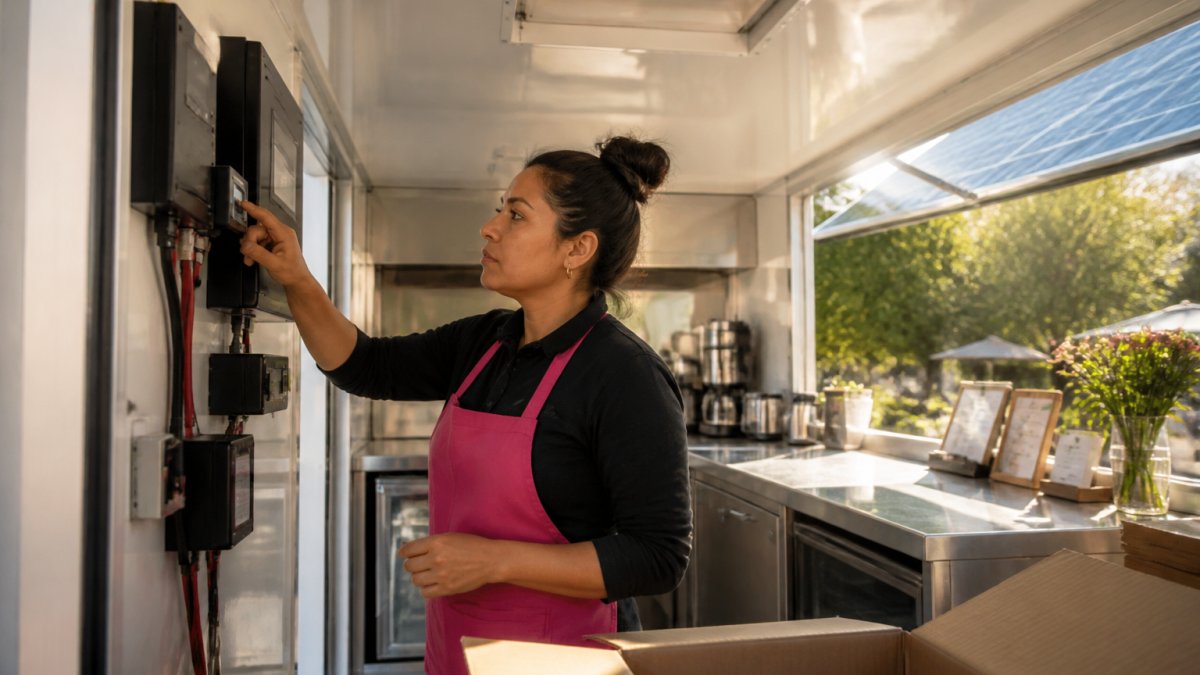
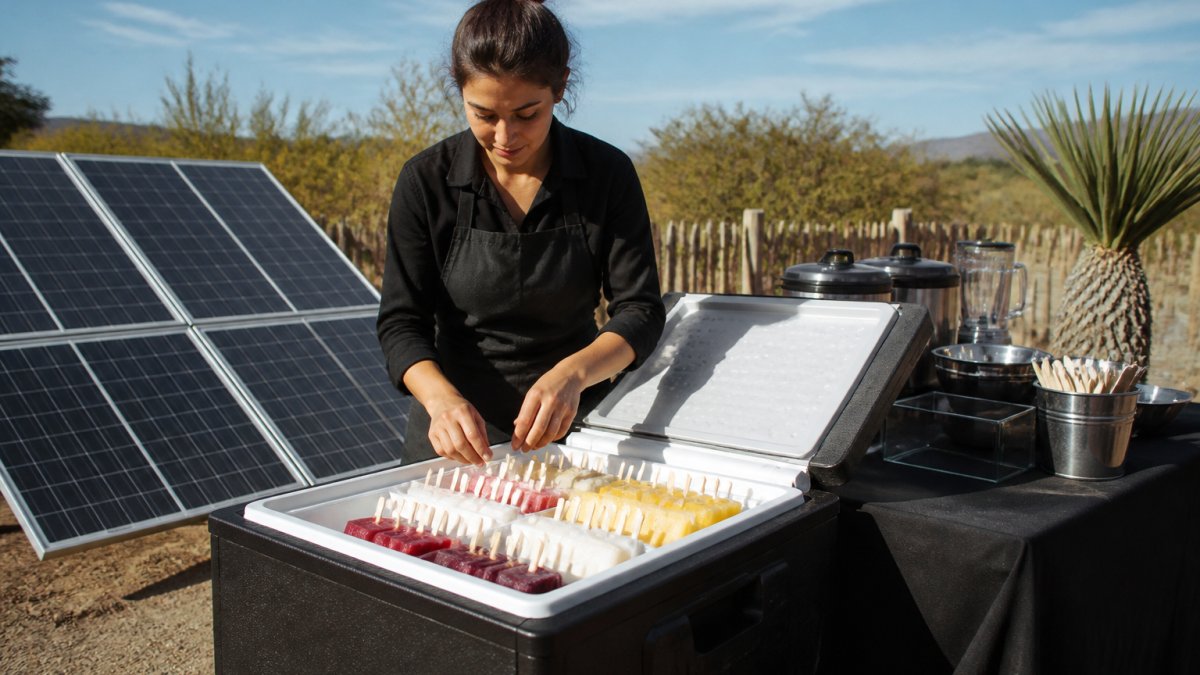
A working solar powered food truck setup follows a clear chain: panels feed the charge controller, the controller charges the battery bank, the battery feeds the inverter, and the inverter supplies standard AC power to your outlets. Scaling this electrical architecture allows for more energy-intensive applications like solar powered roasting, which requires consistent power delivery to maintain precise thermal profiles throughout the brewing process.
The Occupational Safety and Health Administration electrical safety guidance covers the wiring and grounding practices that apply to any mobile electrical system, and skipping them is not worth the risk.
Choosing Off-Grid Catering Equipment That Actually Works
Off-grid catering equipment is any appliance that can run within your system's real limits, not its theoretical ones. The practical filter is startup surge, duty cycle, and continuous runtime, not the wattage printed on the box.
Appliance-by-Appliance Compatibility
Some equipment plays nicely with solar. Some fights it. The difference comes down to three behaviors: whether the load is continuous or intermittent, whether a motor or compressor creates a startup surge, and whether the appliance has a thermostat that cycles it on and off.
| Appliance | Typical Draw | Load Behavior | Solar Compatibility | Watch For |
|---|---|---|---|---|
| LED lighting | 20-100W | Continuous, low | Excellent | Nothing significant |
| POS system and card reader | 50-150W | Continuous, low | Excellent | Keep on a small dedicated circuit |
| Display cooler | 300-800W running | Compressor cycles, 2-3x surge | Good | Startup surge, duty cycling, door openings |
| Reach-in refrigerator | 400-900W running | Compressor cycles, 2-3x surge | Good | Defrost cycles draw extra power |
| Blender or food processor | 300-800W | Short bursts | Good | Run one at a time |
| Exhaust fan | 100-300W | Continuous during service | Good | Runs the whole shift |
| Vertical rotisserie | 1,200-2,000W | Long continuous runtime, motor surge | Fair | Hours of draw, not minutes |
| Electric griddle | 1,500-3,000W | High continuous draw, thermostat cycling | Fair | Two hours at 2,500W is 5 kWh |
| Commercial coffee brewer | 1,500-2,000W | High draw during brew cycle | Fair | Recovery time between pots |
| Microwave | 1,000-1,500W | Short, high bursts | Fair | Surge on start, short runtime |
| Induction cooktop | 1,800-3,500W | High continuous draw | Poor | Sustained high wattage |
| Electric fryer | 2,500-4,000W | Very high continuous draw | Poor | Long heat-up and recovery |
The honest take: high-draw cooking equipment and solar are an uneasy pair. If you are weighing equipment options, the vessels and equipment we work with show what a low-draw service setup looks like in practice.
The Decision Framework
Sort every appliance into one of three buckets before you size anything:
- Solar-friendly: low continuous draw or short bursts, no large surge. Lighting, POS, fans, blenders, small coolers. Run these on solar without hesitation.
- Solar-possible with capacity: compressor-driven or high-draw but intermittent. Display coolers, refrigerators, rotisseries, coffee brewers. These work if you size the battery bank and inverter for surge and duty cycle, and they are the appliances that most often force a larger system.
- Better on propane or grid: sustained high-wattage cooking. Griddles, fryers, induction cooktops. Running these on solar usually means a system so large it no longer pencils out for a mobile operation.
A common pattern is to run refrigeration and electronics on solar and keep cooking on propane. That split lets you downsize the panel array and battery bank substantially while still cutting generator noise and fuel use. The trade-off is that propane adds a fuel supply and ventilation requirement, so plan the layout around both energy sources from the start.
Watch out: assuming a low average draw means a small system. A refrigerator that averages 400 watts over a day can still spike to 1,200 watts at compressor start, and the inverter has to handle that spike every time it cycles.
Food Safety and Compliance When the Power Drops
Power interruptions put food at risk, and the rules do not pause because your panels are shaded. The FDA Food Code sets time and temperature limits for holding food, and state and local health departments enforce them. Cold holding generally means keeping product at 41°F or below. The practical question for a solar operator is not whether an outage happens but whether you can prove what happened to the food while the power was out.
Monitor Temperatures Continuously
A data logger in each refrigerator and freezer is the single most useful piece of safety equipment on a solar catering setup. It records temperature at set intervals, so after any interruption you have a time-stamped record instead of a guess.
Pair the logger with a visible thermometer and check it manually at the start and end of every shift. If you run a display cooler that opens constantly, check it more often.
Know the Time Limits
Frozen food is a different case: it should stay frozen solid, and product that thaws and refreezes is a quality and safety problem even if it never warms past 41°F.
Build Redundancy Into the Plan
A solar system with a battery bank already provides some ride-through, but plan for the case where the bank runs low or a component fails. Options include a backup generator sized to carry refrigeration only, a shore power connection at the venue, or a second battery bank that can be swapped in.
Have a contingency plan for moving perishable food if an outage looks like it will exceed your battery reserve. A nearby commissary, a refrigerated truck, or a partner kitchen can hold product while you diagnose the problem. Decide who you call and where you go before the event, not during it.
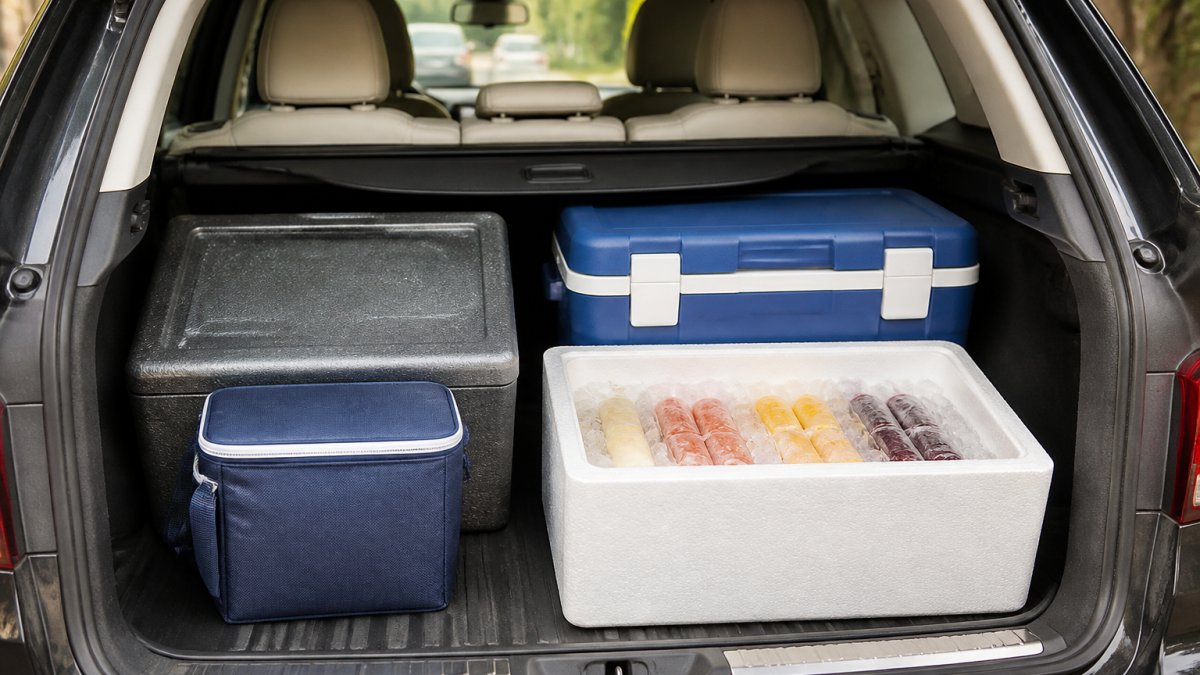
If you are serving frozen items, our guide on how to transport frozen desserts without electricity covers the cold-chain side in detail, and keeping food warm without electricity handles the hot side.
Get a Quote for Electricity-Free Dessert Catering
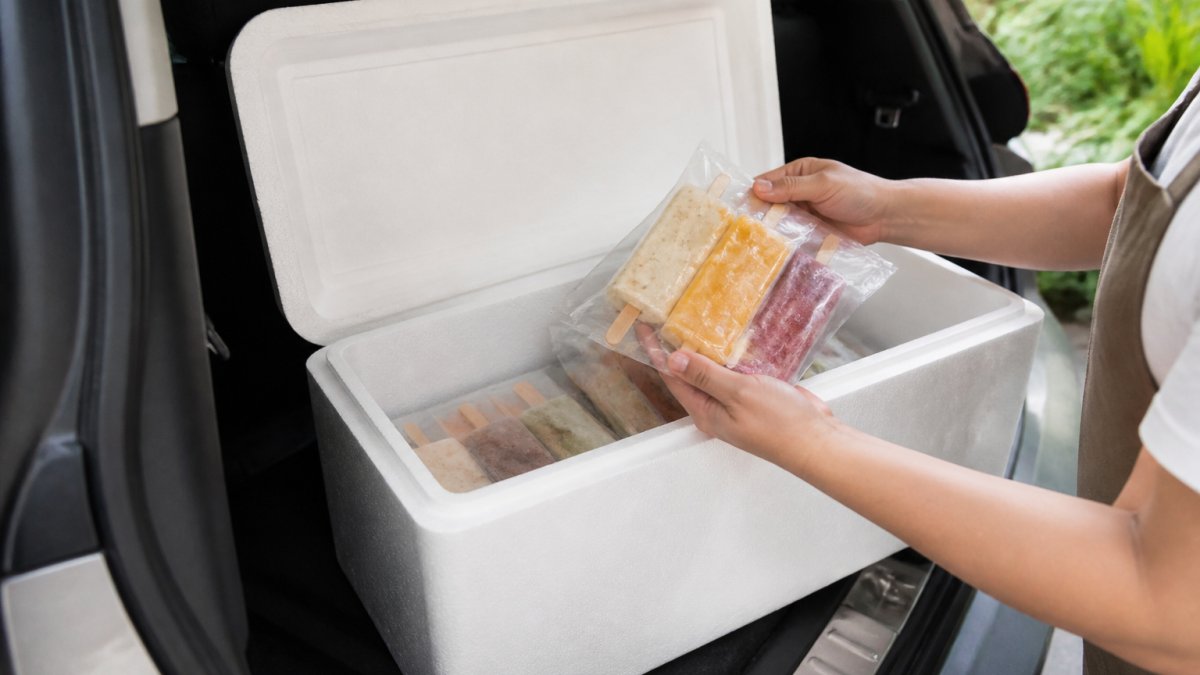
Pepito's Paletas delivers made-to-order vegan paletas in our patented 8-hour frozen signature box, which is designed for an electricity-free catering experience without panels or batteries.
For event planners and office managers who want a sustainable dessert option without building a power system around it, that's the whole appeal.
Pricing depends on quantity, dates, and delivery, so get a quote for your event. If you're still mapping out the broader power plan for an off-grid event, our electricity-free catering planning guide covers the full picture.
Frequently Asked Questions
What catering equipment can run on solar power?
Most low-to-moderate draw equipment runs well on solar: LED lighting, POS systems, refrigerators and display cases, blenders, and small griddles. High-draw items like commercial fryers, ovens, and large vertical rotisseries usually need more panel and battery capacity than a mobile setup can carry. The deciding factor is the equipment load audit: add up wattage and daily runtime for each appliance, then compare that total to your panel capacity and battery storage. Anything with a large startup surge needs extra headroom.
How many solar panels does a catering setup need?
Panel count depends on your daily energy consumption, not the size of the vehicle. A setup running a refrigerator, lighting, and a POS system might need 600 to 1,200 watts of panel capacity, while adding a griddle or espresso machine pushes that higher. Divide your daily kilowatt-hour total by the usable sunlight hours in your area to estimate panel capacity, then add 20 to 30 percent margin for cloudy days and panel inefficiency. Sizing solar panels for food trucks starts with the load audit, not the roof dimensions.
Can solar power run a food truck or catering trailer?
Yes, with realistic expectations. A solar powered food truck can run refrigeration, lighting, POS systems, and small cooking equipment off a properly sized photovoltaic system with battery storage. The limits show up with high-draw cooking appliances and in winter or shaded locations where power generation drops. Many operators pair solar with a backup generator for peak demand days. The setup works best when you match equipment to available power rather than trying to run a full commercial kitchen off panels alone.
Can food be kept safely cold without electricity during catering?
Yes, for a defined window. Insulated holding boxes and frozen delivery systems can keep food at safe temperatures for hours without plugging in, which is why electricity-free dessert catering works for outdoor events. The USDA advises keeping cold food at 40°F or below, so any off-grid setup needs a plan for monitoring temperature and a backup power source if the event runs long or the weather is hot. For events beyond the holding window, battery power for catering equipment or a backup generator covers the gap.
Sizing a solar system for a food truck is a real engineering project, and most catering teams would rather spend that time on the food. Pepito's Paletas removes the problem entirely with a patented 8-hour frozen signature box, made-to-order vegan recipes, and delivery built for luxury events and corporate functions. Get started with Pepito's Paletas and serve a dessert course that never touches a power supply.